The Bat-Brain Project: Smarter Conservation for Our Microbats
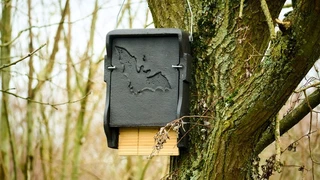
In the quiet hours after sunset, a tiny army of microbats emerges from their hollows to begin their nightly work. These remarkable creatures are the unsung heroes of the Australian landscape, consuming thousands of insects each night and acting as a natural pest control system for our agriculture.
Now, a new project from the Growing Data Foundation (GDF) is set to give these winged warriors a digital helping hand. Bat-Brain is the latest expansion of our ongoing What Lives Here initiative, bringing together community service, ecological research, and open-source technology.
A Collaboration for Biodiversity
The project is a collaborative effort with the Rotary Club of Seaford and the EcoVineyards initiative led by Dr. Mary Retallack. While Seaford Rotary has already installed over 240 microbat boxes across Australia, the Bat-Brain project aims to make these nesting sites “smart.”
“Microbats are essential for functional biodiversity in vineyards,” says Dr. Mary Retallack. “By providing roosting sites, we reduce the need for chemical interventions. But to truly understand how they are using these landscapes, we need data.”
Smarter Sensors for Better Science
The GDF technical team has developed a low-power sensor package designed specifically for microbat nesting boxes. At its core is a low-power MCU (microcontroller unit) with integrated LoRaWAN radio, paired with an IR break-beam sensor to detect the precise moment a bat enters or exits a box — no cameras or physical handling required.
The device also monitors the internal microclimate (temperature, humidity, and pressure) via environmental sensors, providing critical data on conditions within the boxes. All data is transmitted via LoRaWAN to a LoRaWAN Network Server (LNS) and on to an open-source dashboard, allowing land managers and ecologists to monitor dozens of boxes across a vineyard simultaneously. The design prioritises ultra-low power consumption with solar charging support for long-term, unattended field deployment.
Acoustic Monitoring: Hearing the Unheard
Perhaps the most exciting aspect of Bat-Brain is our Acoustic Bat Monitor. Most microbat species use unique echolocation calls that are inaudible to humans. Our system uses a single-board computer paired with an ultrasonic microphone and the open-source Acoupi bioacoustic framework running the BatDetect2 machine learning model to detect and count bat echolocation calls in real-time.
The acoustic monitor captures high-frequency ultrasound and processes it on-device through BatDetect2 — a deep learning model capable of identifying bat calls from audio recordings. Detection data is transmitted periodically via LoRaWAN to our LNS and stored in a time-series database for visualisation on an open-source dashboard.
Why Not TinyML?
While we initially planned to use TinyML on edge microcontrollers, the Acoupi framework on a Raspberry Pi provides more flexibility for running sophisticated BatDetect2 models. This approach also enables easier model updates as we develop Australian-specific classifiers in partnership with local bat researchers.
Next Frontier: Australian Species Detection
Our stretch goal is to train a model specifically for Australian bat species. We’re partnering with local academic bat specialists to collect call data and develop a classifier that can identify our native species—from Gould’s Wattled Bat (Chalinolobus gouldii) to the Little Forest Bat (Vespadelus vulturnus).
Open-Source for Community Impact
As with all GDF projects, Bat-Brain is built on the principles of the “Digital Commons.” All hardware designs, firmware, and documentation will be released openly. Our goal is to empower other Rotary clubs, schools, and conservation groups to build and deploy their own smart nesting boxes.
The project demonstrates how community-led technology can provide the evidence base needed to protect our local ecosystems—moving from simple installation to informed conservation.
Get Involved
The Bat-Brain project is currently in the prototyping and field-testing phase. We are looking for volunteers with skills in electronics, software development, or ecology to help us refine the system.
To learn more or to contribute to the project, join our community on Slack or contact us directly.